Showing posts with label books. Show all posts

Friday, March 8, 2013

"Hacking Your Education," by Dale J. Stephens


Dale J. Stephens left traditional school at 12 years old to become an unschooler. After giving college a try, he discovered that fellow students were more interested in partying than learning. He quickly concluded that if the best experiences were to be had outside the classroom, it made no sense to pay tens of thousands of dollars to sit in the classroom. He dropped out of college, and ended up founding Uncollege.org.

In his inaugural book, Hacking Your Education: Ditch the Lectures, Save Tens of Thousands, and Learn More than Your Peers Ever Will, Mr. Stephens proceeds to undo the myth that a college degree guarantees job security and happiness. He shows that with a little gumption, people can create their own educational path, build networks of mentors and supporters, and make some close friends along the way.

Hacking is often associated with computer hackers, tech-savvy people who break into computers to spy or drop viruses. In the sense of education, hacking means breaking away from the tradition-bound structure of education to design an lifelong learning mentality which doesn't rely on being spoon-fed what those in academia assume is needed in the real world. Mr.Stephens does make an exception for careers that require highly specialized training, such as medical doctors, but perhaps even they could benefit from a little hacking.

In addition to describing his experience with education and real life, Mr. Stephens shares the stories of others who have taken it upon themselves to be responsible for their own learning and success. We meet Tiffany Mikell who, despite being a young black single mother without a college degree, discovered a talent for JavaScript programming and ended up working at Accenture. We learn about Christian Keller, who dropped out of school when he was thirteen and is now, at 25, working on a film with Barrie Osborne (producer on Lord of the Rings and The Matrix). The pages are littered with people who took control of their education.

One of my favorite parts of Hacking Your Education is the "Hack of the Day" at the end of each section. Each "Hack of the Day" focuses on the idea just presented and gives hands on tools for incorporating it into your life. Whether it's planning a "brain party," finding out "what you aren't talented at," or making "the most of $100 a week," the ideas are doable and in small enough doses that they don't become overwhelming. Even though I am well beyond my college years, I look forward to trying many of these ideas to expand my experiences and create opportunities for my children.

Mr. Stephens is an extrovert, so many of the techniques he uses come easily to him. He acknowledges this and suggests a more low-key approach for the introverts among us. Even doing a little of what he describes will put most people light-years ahead of the crowd stuck in college lectures on subjects they must take in order to get to the classes they really want to attend in two or three years.

I do have one quibble with the book, and that is the use of profanity. As I have already admitted, "young" parted ways with my "adult" many years ago. I also realize that this book is aimed at older teens to young adults, not their parents. While interspersing the f-word here and the s-word there may make Mr. Stephens sound like one of the people his book targets, those very words detract from the message, drawing attention away from the text and instead pulling it to themselves. This is language one may use among friends, but certainly not when putting on our adult persona. And the author (and editor, who should have excised these from the text) needs to remember that many parents will be reading this book before passing it on to their kids. There is a market beyond the target, and writers and editors need to be sensitive to those pocketbooks.

Having said that, I still recommend Hacking Your Education. The overall message and specific action items far outweigh any language issues. Going into debt for an education that guarantees nothing but classes, homework, and a piece of paper, doesn't make sense in this age of information access. With a library card, Internet access, and passion, people can create their own path in life, without the debt and lost time. Hack your own education and see what it brings!

Friday, August 17, 2012

"Dismantling the Inner School," by David Albert

Although we may homeschool our children, most of us still went through the traditional school system. We grew up believing that being cooped up in a classroom for the better part of the day with 30 kids our age and one adult, all learning the same thing at the same time, and being told when we could and couldn't use the bathroom or go out a play or read or talk or sit and ponder or ask questions was normal and desirable. Our parents had done it before us, and probably our grandparents before them.

We may believe that by choosing to homeschool that we have broken away from the system. Yet, so many of us still find ourselves trying to replicate school at home, or comparing our children's progress to their agemates', or wondering if we're doing enough based on what we think is going on behind the closed doors of our local school.

David Albert addresses these issues head on in his latest book, Dismantling the Inner School: Homeschooling and the Curriculum of Abundance (Hunt Press 2012). In a series of essays, David argues that we parents need to remove the bricks that "block us from true, natural learning," and understand that children start learning from the moment they start living. Learning is a natural response to life, but school is designed to undermine and subvert this innate desire, preventing children from experiencing with all their senses, which is originally how we learn.

For those who are unfamiliar with David Albert, he is a homeschooling father, speaker, writer, and advocate. He readily questions much of what is commonly accepted about school, learning, and even intelligence. He is an engaging speaker and writer, who encourages dialogue, whether verbal or virtual.

In Dismantling the Inner School, David takes to task much of the research and many of the claims surrounding school. He doesn't merely question the findings, but looks at them from a completely different angle. For example, David cites the well-reported research about how ADHD symptoms in children virtually disappear with regular exposure to the outdoors. Much of the reaction to this research centered on introducing nature programs in schools, creating green spaces in cities, and the like. David looks at all this and instead infers that perhaps kids being shut inside all day at school is causing ADHD, and therefore, school is the problem, not the kids.

But, the book doesn't just attack systemized schooling, it provides ideas, suggestions, and examples for approaching learning in our everyday world. Whether discussing ways to include children in adult activities within families and communities (an "apprenticeship of thinking") or giving specific information about books and websites to enhance the learning experience, Dismantling the Inner School inspires readers to explore the "curriculum of abundance" that exists in our lives. Readers are advised to keep a paper and pen handy to jot down all the tips for future reference.

Dismantling the Inner School is good for new and experienced homeschoolers, alike. In fact, it wouldn't be a bad idea for a school teacher or adminstrator to take a gander. Imagine the real educational reforms that could happen if those in charge of the system decided that learning came before classroom management.

Dismantling the Inner School: Homeschooling and the Curriculum of Abundance is available through David Albert's website, www.skylarksings.com. Supporting members of the Gifted Homeschooling Forum receive a $2.00 discount on this and all of David Albert's books ordered through his website.

Wednesday, October 5, 2011

Murderous Maths

Too many of us believe that math must be taught with lecture, followed by worksheets, wrapped up with tests. Only after showing proficiency in a particular area may a student proceed to the next step.

Boring!

Where are the colorful characters that developed math as we know it? Where are the problems that stumped humankind for generations, until some creative soul said, "Aha!" Where are the explanations of the purposes and applications of all this math? Nowhere in a traditional textbook, that's for sure.

Supplementing mathematics with books about math (as opposed to "math books") can bring a traditionally dry subject to life. Why math isn't taught like this in schools, I have no idea. But you're homeschooling, aren't you?

A wonderful addition to any home library is the Murderous Maths series written by Kjartan Poskitt and published by the same folks who gave us Horrible Histories, Horrible Science, and Horribly Famous series.
With intriguing names like Numbers, the Key to the Universe, Mean and Vulgar Bits, and Do You Feel Lucky?, students will hardly realize that these are math books. Text is combined with cartoons, illustrations, humorous asides, and knowing nods to the reader, all with the attitude that this is stuff your teacher doesn't want you to know and maybe doesn't even know himself.

Please don't make the mistake of thinking, "My child has barely memorized the multiplication tables, so how can she understand more complex math?" These books introduce new ideas in a fun and engaging manner. While a reader may not be able to solve a page of calculus after reading these books, she will have been exposed to more advanced formulas and equations, read about shortcuts and tricks, and generally found math entertaining

On a personal note, my eldest son has just about read the ink off all the Murderous Maths books he has. Many's the night he's come bounding down the stairs to share some new insight he's gained from the books. Enthusiasm for mathematics is worth every penny.

Article by Sarah J. Wilson

Tuesday, August 9, 2011

"Visual-Spatial Learners" Review

As any parent of multiple children can tell you, each one is very different from the others. What works with one child is doomed to fail with the others.

This is certainly true when it comes to helping our children learn. That fine system you put in place for your first child will collapse in heaps when the second child comes along.

Figuring out your child's learning style can give you insight into ways to better reach them and open up the world to their inquisitive minds.

Typically, schools are designed with the auditory-sequential learner (ASL) in mind. This child thinks in words, learns well from instructors, is a step-by-step learner, and so on. They tend to fit very well into the classroom system.

Then there are the other students, the visual-spatial learners (VSLs). These children think in pictures, develop their own methods of problem-solving, are whole-part learners (understand the big picture, before they grasp the parts that make it), and so on.

If you are an ASL, or your other children are ASLs, and you are now faced with a VSL, figuring out how to best present new material and learning opportunities can be frustrating. What worked before, simply does not work now.

This is where Visual-Spatial Learners: Differentation strategies for creating a successful classroom, by Alexandra Shires Golon, can help.

Don't let the title throw you. Although Golon definitely directs her advice to classroom teachers, most of what she suggests can readily be put into action in the homeschool environment.

Golon starts by relating an activity she gives to teachers. She has them draw a 2"wide x 1/2" tall rectangle, a space similar to the signature line on a check. Then she asks them to place their pen in their non-dominant hand and sign their name within that box. She inevitably hears groans and moans from the teachers about the awkwardness and difficulty of the task. She then tells them that this is what it feels like for a "right-hemispheric, visual-spatial student sitting in a left-hemispheric, wor-dominated classroom."

Readers of Visual-Spatial Learners can either read the book cover to cover or jump to the specific chapter(s) which interest them. (How's that for ASL versus VSL accessibility?)

Golon addresses the basics of elementary education: reading, writing, spelling, note-taking, mathematics, and organizational skills. Timed tests, written agreements, and creating a visual-spatial classroom may not apply to homeschoolers, but the basic skills are universal. Quite frankly, having taught in a classroom environment, I find many of her suggestions overwhelming wih 30-35 kids in mind (I have all this required stuff to do, and now you want me to do more?); but, as a homeschooling mom, I find her suggestions really simple to incorporate in our learning.

For example, VSLs often have lousy writing. But when writing is presented to them as art, such as with calligraphy, their handwriting skills improve immensely, as does their ability to and joy in communicating through the written word.

When it comes to math facts, all sorts of tricks come into play. Golon presents hand games, lattice multiplication, drawing assignments, and more, to help VSLs create mental pictures of mathematical information.

Perhaps her most powerful message is that, just as children learn differently, the way they present that knowledge should be different. Not all children want to write down what they're learned. Some may better demonstrate mastery through building a diorama or designing a poster or putting on a play. We, as homeschooling parents, are in an excellent position to gauge learning through unorthodox methods.

Visual-Spatial Learners will give homeschooling parents a deeper insight into their VSL children, as well as tools to create and support learning opportunities to fit their children's needs. VSL children will develop confidence in their ability to learn, explore, and understand their world in their creative, big-picture, enthusiastic way.

Wednesday, July 27, 2011

Fundamentals of Homeschooling: Notes on Successful Family Living

Every once in a while, a book resonates with what I believe from page one, making me wish that I had been able to write the book myself. On the first page of Ann Lahrson-Fisher's Fundamentals of Homeschooling she says, “Homeschooling success builds on this simple foundation: living a satisfying learning lifestyle.” Those five words—living a satisfying learning lifestyle—summed up my deepest hopes and dreams for how my children would grow up, even before we started homeschooling.

The book is divided into six parts (Play, Conversations, Togetherness, Growing Up, The Big Picture, and Subjects), each beginning with a “Keynote” describing some big ideas about that concept and followed by several easy to read chapters about some specific topics within that concept. Each chapter can be read in isolation, so a tour of the table of contents can take you to your current hot-button topics. However, I feel the book is best read one part at a time, because of the way the author links the topics together.

In Part One: Play, the author gives an overview of the value of play and then goes on to describe a number of ways that we can manipulate our home environment to encourage play that supports a learning lifestyle. There are several lists of toys, games, and learning materials, and a whole chapter is devoted to modifying games to meet the needs of different ages and temperaments.

Part Two describes how “family chitchat” can become a vehicle for learning. Some
examples may seem familiar or simply intuitive, others are fresh and new. Several
chapters are devoted to both language arts and math. The last chapter of the section talks about how conversation can be used for everything from teaching self control to learning how to handle mistakes.

These first one hundred and thirty pages make this book worthwhile for even the family whose children are attending public school, because they describe a set of skills and opportunities that all families can take advantage of. Because of this, I've given this book as a gift even to friends who aren't homeschooling.

Beginning with Part Three, Togetherness, the book discusses many issues specific to
homeschoolers. Chapters describe everything from homeschooling styles to yearly planning to handling criticism to homeschooling with a baby on your lap.

Part Four is about the end of the homeschooling journey, as children grow up and become adults. It gives many suggestions about how homeschooling families might approach this rite of passage into adulthood.

Part Five explores some tools that homeschoolers use to enhance learning such as field trips, learning clubs, and apprenticeships.

Part Six includes a chapter for each of nine subject areas, with some big ideas about homeschooling each, followed by a list of selected resources for that subject area.

Although each idea in Fundamentals of Homeschooling may be explored more deeply in
other books, Lahrson-Fisher neatly sums up the most important points about each in an easy to digest text that reads like a letter from a good friend. I've found comfort in this book more than once because I always come away with the feeling that “I can do this.” I appreciate her emphasis on the family and learning to live comfortably together as we take the learning journey.

Wednesday, June 22, 2011

Exploratopia

If you've ever had a chance to go to the Exploratorium in San Francisco, you know what a magical thing science can be.  The Exploratorium's curators, educators, and scientists have created exhibits that draw you in and keep you interested.

The book Exploratopia might be the next best thing to visiting the museum itself.  It's my favorite experiment book because the text is interesting, it doesn't talk down to kids, and it's filled with experiments about everyday things kids are fascinated with already-- like the toilet and ants!

The book begins with an explanation of the "Tools for Exploration," a sort of primer for how to think like a scientist.  This is not just the scientific method, but also things like "Paying attention to stuff a lot of people ignore."  Periodically, these tools are revisited in the experiments.

The rest of the book is divided into three major sections: Exploring Yourself (experiments about your senses and brain), Exploring Interesting Places (experiments you can do from the kitchen, to the backyard, to the amusement park or beach), and Exploring Interesting Stuff (experiments about more conventional topics like light and sound and less conventional ones like music and money).

Each experiment has a section for what you need, what to do, and "What's going on?" with additional sidebars providing related information and exploration ideas.  The illustrations are a mixture of photography and colorful drawings.

So if you've ever wondered what would happen if you substituted Vaseline for oil in a spice cake, how sounds echo in your toilet, how to shrink a friend, or what you can find with a magnet at the beach, this is the book for you!  It would make an excellent gift for a curious child and a great "spine" for a homeschooling family looking for science curriculum.  Although many of the experiments could be completed by a younger child, it's best suited for independent readers ages eight and up.

Wednesday, June 8, 2011

Teaching Pet Safety

When introducing a new dog or cat to the family, parents usually lay down a few rules, such as who is responsible for feeding and cleaning up after the animal, and whether or not the animal is allowed on the furniture. Beyond that, problems are handled as they arise, which can lead to negative interactions between children and pets. All too often, these issues can result in the child fearing the animal, the animal being given away, or even the animal being put down, none of which are desirable.

If you are thinking of owning a dog or cat, or simply want to teach your children how to best interact with them, check out Dr. Amanda Chin’s workbook, Pets' Playground: Playing Safe in a Dog-And-Cat World.

Loaded with information on the history, behavior, and care of dogs and cats, Pets' Playground provides a wonderful, fact-filled way for families to learn together. The text is around a third-grade level, but it is ideal for reading together. The pages are filled with photographs and illustrations. Matching games, mazes, drawing activities, and fill-in-the-blanks are scattered throughout the workbook. Additionally, more advanced words are used, but they are quickly defined in a matter-of-fact manner, and a comprehensive glossary can be found at the back.

Dr. Chin strives to give useful information without creating fear. For example, instead of simply saying, “Don’t approach strange dogs,” she demonstrates through illustrations and explanations pets’ body language, how to approach animals, and what to avoid doing to them. Dr. Chin discusses how to make a home pet-safe, what pets should and should not eat, and what to expect at vet visit.

On a personal note, we used this book with our two sons. Our eldest has a strong fear of dogs, which we have slowly worked to mitigate. This book was a part of that process, filling his mind with facts and numbers, which made dogs seem less intimidating to him. Our youngest son has no fear of animals, and therefore was a little too enthusiastic with his displays of affection toward our cats. We used this book to show him how cats like to play and how to read their signals better. Our eldest still is wary around new dogs, but warms up to ones he sees repeatedly. Our youngest is much better about petting the cats (“Head to tail, Mom. Head to tail.”)

For more information on this book and other pet issues, visit Dr. Chin’s website at www.kidsandpetsafety.com.
Article by Sarah J. Wilson

Thursday, June 2, 2011

Win a Copy of "Zenschooling"!

Are you interested in reading Zenschooling, by Tammy Takahashi, but haven't picked up a copy yet? Now's your chance to win a copy at Hunt Press' blog

Just click through and scroll down to the announcement. Make sure to leave a comment on the blog or send one by email to info@huntpress.com by June 7th! That's when Hunt Press is picking one lucky person to receive a free copy.

Good luck!

Article by Sarah J. Wilson

Saturday, May 21, 2011

Coming July 2011: "Making the Choice" from GHF Press

Catch the New Release from GHF Press!

GHF Press is pleased to announce the new book by Corin Barsily Goodwin and Mika Gustavson, Making the Choice: When Typical School Doesn't Fit Your Atypical Child.

A guidebook for parents considering homeschooling, Making the Choice discusses how to balance the emotional and academic needs of gifted and 2e children, their parents, and their families.

In Making the Choice, Corin Barsily Goodwin, Executive Director of Gifted Homeschoolers Forum, and Mika Gustavson, MFT, demystify and de-mythify some of the perceived barriers to homeschooling. For those families wondering if this is an option they should consider, Making the Choice offers ideas, guidance, and encouragement to fully evaluate the option.

Making the Choice is first in a series by GHF Press on Perspectives in Gifted Homeschooling, designed to bring more resources and information to the world of gifted, intense, and twice-exceptional children and their parents.

Making the Choice will be available in print and e-book formats in July 2011.

Monday, May 16, 2011

The Bible as Literature


Living where I do, one comes across many homeschoolers who are not Christian. A significant portion of those, while comfortable teaching ancient Greek and Roman mythologies, Native American belief systems, and perhaps even Eastern religions, struggle with Judeo-Christian beliefs.

While I am not here to debate the veracity of anyone's belief system, I will argue that students must read and understand the Bible if they are to have a full education.

How can anyone understand disputes in the Middle East without knowing Hebrew history as told in the Bible? How can anyone understand the symbolism of Western art and architecture without knowing the biblical parables and characters? A deeper knowledge of Western literature, history, medicine, and science are lost if the Bible is ignored. Current events are even more confusing if ancient history and beliefs remain unknown.

Studying the Bible (or any other religious text) is best done as a family. Parts of the Bible are contradictory, inflammatory, or even risque. Children's bibles and biblical story books gloss over this, naturally. But, if we are treating the Bible as "literature," then we must address it as is, warts and all.

An excellent study Bible, one often used in college "The Bible as Literature" courses, is The Oxford Study Bible: Revised English Bible with Apocrypha. Written in modern English, The Oxford Study Bible contains much more than biblical text and the usual explanation of abbreviations. This version includes "Reading the Bible," "Literary Forms of the Bible," "Communities in Context," "The Literature of the Biblical Communities," "The Communities' Experiences of God," "Select Index to People, Places, and Themes in the Bible," and 14 indexed maps.

The Old Testament, Apocrypha, and New Testament are annotated, adding clarity to confusing passages and historical context lost on modern readers. Each book begins with a brief explanation of the book's historical and spiritual intent. Headings at the top of each page give a one-sentence summary of the content, allowing the reader to have an overview of what's happening.

Studying the Bible in conjunction with other subjects adds a deeper understanding to both endeavors. The poetry of the Bible inspires poetry of today. The battles fought in the Old Testament fortell the battles still fought on the same ground, thousands of years later. The contradictions within the Bible feed the contradictions within the various sects of Judeo-Christian belief. The humility of the great leaders in the Bible are examples for leaders of today. The hubris of others also stands as lessons for those same leaders.

Use the Bible as a jumping off point for discussion and debate. Why are there two creation stories in Genesis? Why does the lifespan of mankind decline as we go through the ages? How does the personality of God change from the Old Testament to the New Testament? Why was the Apocrypha debated, partly included, completely excluded, and still not a consistent part of the Bible? Why were none of the four Gospels included in the New Testament written by anyone who actually knew Jesus? What similarities do you see between stories and parables in the Bible and other religious writings, and what does that tell us about what is important to humanity? How are women depicted in the Old Testament compared with the New Testament, and why the change? Why has the Bible, in one form or another, inspired people to great good and great evil for over two thousand years? (Remember, the Bible is a Christian document, and includes the Old Testament to illustrate Christianity's link to and succession of Judaism through Jesus, a Jewish carpenter, born of a Jewish mother.)

As a society, we have already lost so much in our understanding of our past through the loss of regular study of Greek, Latin, and ancient texts. If we toss aside the Bible as well, our history, literature, and art will become all the more shallow and meaningless.

Article by Sarah J. Wilson

Sunday, May 8, 2011

Which Came First: The Speech Delay or the Creativity?

My youngest son has a speech delay, not talking until he was nearly three. Two years later, he chats all the time, but doesn't always speak clearly, especially when he's excited. He's been tested and evaluated, been in speech therapy, but no one knows why he was delayed. It's just one of those things.

An interesting aspect of his delay is that he doesn't always remember the names of newer objects, especially if the names don't correlate with how he views the objects.

For example, he came into the house today, asking me to hold the "long orange styrofoam bending tube so [he could] use it like a pipe." Do you know what he was talking about? An orange pool noodle. How did he want to use it? He wanted to place it over a hole and pour water down it.

What I find fascinating about this is the visual images he creates through his descriptions. Foods he can't name are describe by color, size, and taste ("the cheese that is orange and a big rectangle and is good for grilled cheese sandwiches"). Clothes are describes by color, design, and a personal connection ("the pants that are green on the outside and light brown on the inside and pull up and were my brother's but are mine and Nana made them"). Parks are described by the size of the sandbox, the toys he likes to use there, the location of the parking lot, and where we went after we'd visited the last time ("the one with the really big sand box and the wood chips and I make castles and we went to Peet's last time").

Of course, after a few goes, he does remember the common names (cheddar, sweatpants, and a park locals will know), but I wonder if his in depth descriptions stay connected in his brain, creating a richer view of his world. He is definitely more experimental and daring. He seems to view the potential of an object, instead of being limited by its reality.

Is this truly a side effect of his speech delay, or was his speech delay due to this complex thinking? Who knows. I don't really care. What is important is that we encourage his creative processes, because we need more people who see the greater potential in the world around them.

Despite claims to the contrary, school squelches creativity. It must, in order to deal with the number of students with all their issues placed in the care of a few adults, in order to accommodate all the testing necessary to justify salaries and spending, in order to get through what students "must know" if they are to be productive adults. While a child who looks at his desk and sees a flight console might be charming before the bell rings, once the bell rings, that child had better come back down to Earth and sit quietly at that desk and be prepared to be educated.

When you think about it, speech delays, autism, Asperger's, dyslexia, dysgraphia, ADD/ADHD, and all the other learning "differences" that get diagnosed and treated aren't new. These didn't just appear in the last 30 or 40 years. They've probably been around since humanity began. So, are they really problems, or just a function of the diversity of humanity? Have they always been problems, or are they only problematic in a strict, narrow learning environment?

After all, if you look at many of our great artists, thinkers, writers, builders, scientists, and creators in history, you will find people who may have been prime candidates for these diagnoses. Imagine if they had sat in room from the age of two or three, four to eight hours a day, five days a week, until they turned eighteen, at which point they were then informed that they must now complete another four, six, or even eight years before their ideas, thoughts, and visions would be taken seriously.

Now, some folks may think I am anti-school. I am not. I am anti-traditional-education. People, not just children, do not learn best by being told, "You are x years old, therefore, you must learn y. You are not ready to learn z, because people your age do not get taught z. And, no, q has nothing to do with c, because the textbook says it doesn't."

We need to recognize that differences aren't bad. They are simply differences. We don't all learn the same way, and that's O.K. We don't all view the world the same way, and that, too, is O.K. What a dull and static world we'd exist in if we did.

If you would like to read more about people with learning differences, please check out these books:
The Way I See It: A Personal Look at Autism and Asperger's

Thinking In Pictures: and Other Reports from My Life with Autism

The Survival Guide for Kids with LD*: *(Learning Differences)

Homeschooling the Child with ADD (or Other Special Needs): Your Complete Guide to Successfully Homeschooling the Child with Learning Differences

If They Can Do It, We Can Too!: Kids Write About Famous People Who Overcame Learning Differences Similar to Theirs

The Mislabeled Child: How Understanding Your Child's Unique Learning Style Can Open the Door to Success

Mellow Out, They Say. If I Only Could: Intensities and Sensitivities of the Young and Bright

In the Mind's Eye: Visual Thinkers, Gifted People With Dyslexia and Other Learning Difficulties, Computer Images and the Ironies of Creativity

Article by Sarah J. Wilson

Thursday, May 5, 2011

"The 10 Things All Future Mathematicians and Scientists Must Know (But are Rarely Taught)"

With great power comes great responsibility.[1]

Budding mathematicians and scientists would be best to remember this. Simply because one can understand complex theories, does not preclude one from making common errors.

The Ten Things All Future Mathematicians and Scientists Must Know (But are Rarely Taught), by Edward Zaccaro, lays out ten concepts to guide students to more critical and honest thinking. Students don't need to become mathematicians or scientists to benefit from these ideas.

By discussing actual events that were affected by the misunderstanding or delibrate disregard of facts and calculations, Mr. Zaccaro brings home the importance of understanding and accepting what numbers mean.

We adults can probably think of tragedies in our lifetime that ultimately came down to math or science: the Challenger explosion, the Kansas City Hyatt Regency walkway collapse, the death of Aaliyah. The Ten Things explores how these events could have ended differently, had the numbers and facts been taken seriously.

Fortunately, not just tragedies are covered. Mr. Zaccaro uses the strange world of average speed, cold fusion, the Mars Climate Orbiter, ulcers, psychic surgery, doctors who were fooled, the Bermuda Triangle, how ethical decision-making saved a company, knee surgery, and more to discuss why mathematicians and scientists (and, arguably, all of us) need to move beyond the cold facts and figures, instead utilizing them to make better decisions, safer choices, and strongly-founded conclusions.

Each chapter supplies several examples of incidents which support the topic. Each example is reviewed, the mistakes laid out, and then followed by discussion questions. The questions range from specific (why was something done) to open-ended (what do you think).  Along the way, mathematic and scientific concepts are introduced and explained, never assuming the reader is an expert, but always teaching. Additional questions are given at the end of each chapter, ranging in difficulty from "Level 1" to "Einstein." Answers and explanations are in the back.

Lest all this sound overwhelming, rest assured that the book is appropriate for middle-school and higher. Of course, don't hold back the book if a younger child is interested in reading it. (My eldest son first read it when he was seven.) I would also encourage parents to read it, as we could all use a refresher course in critical thinking, especially when we're inundated with "facts" and "truths" through media, the Internet, and "friends of friends."

The Ten Things All Future Mathematicians and Scientists Must Know (But are Rarely Taught) is an excellent companion to any math or science program. It also works as a stand-alone book for inviting family discussions, a part of family life-long learning.

[1] This quote, in various forms, is attributed to Jesus of Nazareth, Voltaire, Rudyard Kipling, Karl Marx, FDR, Stan Lee, among others. (http://www.newsfromme.com/archives/2005_10_06.html; http://en.wikipedia.org/wiki/Uncle_Ben#.22With_great_power_comes_great_responsibility.22)

Article by Sarah J. Wilson

Tuesday, May 3, 2011

"What Really Matters": Focus on Learning, not Educating

Homeschoolers easily get bogged down in the minutea of their everyday lives. We risk spending more time worrying about doing the right things for our children, instead of actually doing things with them. What should be an experience filled with joy and freedom becomes a drudgery laden with frustration and disappoinment.

What Really Matters: Two veteran homeschooling advocates discuss what learning is really all about, by David H. Albert and Joyce Reed, strips away all the extraneous matter we tend to add to our homeschooling lives, leaving us with what really matters: fostering the love of learning.

Beetween them, Mr. Albert and Ms. Reed parented and home-educated seven children, all who have gone on to lead successful lives. Yet, neither David nor Joyce approached homeschooling as an educational style; instead, they viewed it as a lifestyle, one which opened up a realm of learning possibilities to the entire family.

Readers are drawn into the written conversations between the authors, becoming part of the discussions. Each chapter is self-contained, with titles, such as "Secret Spaces, Hidden Places," "Hyrogrifix," "Perfection is the Enemy of Excellence," and "On Trauma, School Disease & the Way Forward." These thoughtful and thought-provoking essays will open up new avenues of thinking for many homeschoolers, while reaffirming the paths of others.

Ever wonder what the purpose of college is for students who already know how to learn independently? Check out "Why Go to College?" Ever sat with your child, struggling to get her to do workbook pages? Take a moment to read "Workbooks." Fear your children are growing up too fast? Sit down with "Time After Time . . ."

What Really Matters is available through a variety of small bookshops and online retailers. As always, supporting members of the Gifted Homeschoolers Forum (GHF) will receive $2.00 off the listed price when they purchase the book through David Albert's website, www.skylarksings.com.

Article by Sarah J. Wilson

Thursday, April 28, 2011

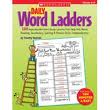
Word Ladders

The Daily Word Ladders books by Scholastic are a great resource for building vocabulary and spelling skills.

Available for grades 1-2, 2-3, and 4-6, each book uses the same concept at increasingly difficult levels. Each page shows a ladder of 5 to 10 rungs. The first rung has a word. The second rung gives a clue for the word that belongs on the next rung and lines for each letter of that word. For instance, on one ladder the first word is "coat" and the clue for the next rung is "A black rock that produces heat. Change one letter." The activity continues in this manner, with clues to add, subtract, rearrange, or change letters to create a word with a particular meaning until you reach the top rung. Each page has a theme to which the top and bottom word belong-- so "hot" may be turned in to "cold" or "coat" turned into "glove".

The wonderful thing about word ladders is they combine the elements of a game with some great brain exercises. It's fun to discover that changing a single letter changes the sounds of almost all the letters around it. These books are a great addition to vocabulary and spelling curriculums.  We don't use them daily in our family, but they are a fun alternative to our regular curriculum.

Wednesday, April 27, 2011

"Exploring the Back Roads": Stretch Your Field-Trip Muscles


This post contains Amazon Affiliate links. As an affiliate, I receive a small commission on items sold through my store or my affiliate link.


Homeschoolers love field trips. What better way to experience the world, than to actually get out and explore it?

Sometimes, however, we find ourselves stuck in a rut. We start going to the same museums, the same parks, the same historical sites. The kids get bored. We get bored. And the family ends up staying home.

If you live in, or plan to visit, the Bay Area of California, you now have no excuse! Peter Browning's book, Exploring the Back Roads: 28 Day Trips in the Greater Bay Area, is filled with new and interesting suggestions for places to go.

Dedicated to "the guy who invented second gear and the illegal U-turn," Browning's book opens up a world of field trips to even the least adventurous among us.

Exploring the Back Roads divides the greater Bay Area into four areas: Marin to the Sonoma Coast; Wine Country to the Geysers; Carquinez, the Delta, and Contra Costa; Santa Cruz Mountains, the Coast, and Old San Juan. Naturally, distances to these areas varies greatly depending on where in the Bay Area you live, but most can be easily done in one day. If some seem a bit far, include them in a two- or three-day trip, or tack them on to a road trip headed to a far-flung destination.

Browning provides plenty of information about each trip, such as pictures, maps, history, nearby parks and restaurants of interest, and so on. The ultimate destinations aren't an end unto themselves, but part of a greater journey on picturesque roads, past beautiful scenery, and through parts of our area most people miss.

Our family has done a few of the field trips (Lick Observatory, San Juan Bautista-Fremont Park, Santa Cruz to Castroville), adapting the suggested sites and drives to suit our family's interests and needs. We have noted even more of Browning's suggestions in our "Places We Like To See" binder (look for more information in a future article).

For more field trip ideas,
check out GHF's Virtual Field Trips page.
A few suggestions for those using Exploring the Back Roads, or any other travel guide:
1) Check, either online or by phone, for current hours at your destination. Browning last updated his book in 2006, and some locations have made changes since then.

2) Map out your excursion using online or printed maps. You will get a better idea of actual drive times and distances from your location.

3) Either plan ahead for bathroom breaks, or be on the lookout while driving. I never cease to be amazed at how fast a child's bladder works once in the car.

So, pack a picnic, belt those kids in the car, and hit the road. Book-learning is good, but real-life learning is amazing!

Article by Sarah J. Wilson

Friday, April 22, 2011

"Zenschooling," by Tammy Takahashi

Homeschooling, like life, can quickly become an overwhelming endeavor. All too often, we concern ourselves with comparing ourselves to others, trying to gauge where we rate, instead of allowing ourselves to simply experience the journey with all its ups and downs.

Tammy Takahashi's latest book, Zenschooling: Living a Fabulous & Fulfilling Life Without School, shows us how to relax and allow learning to happen naturally. Guided by her studies in Zen Buddhism, Ms. Takahashi approaches life as a series of opportunities to release our death-grasp on the fears and attitudes which limit our openness to new experiences and different points of view.

Chapters such as " Finding the Perfect Education," "When Parenting and Education Collide," "Getting Things Done and Increasing Efficiency," "Cultivating Patience," among others, will resonate with homeschoolers struggling to create the "perfect" learning enviroment for their children, while trying to juggle the realities of day-to-day life.

Ms. Takahashi peppers Zenschooling with Zen koans, proverbs, and insightful tales of Zen masters and their students. These koans, proverbs, and tales add a deeper dimension to the topics being discussed, often offering a humorous take on common worries.

Despite her humor, Ms. Takahashi doesn't shy away from her own struggles. Her honesty about her life allows us to see ourselves in her words, opening us up to better learn from her advice.

Zenschooling is not a "how-to" book of homeschooling. It doesn't give step-by-step instructions on curriculum or planning. Instead, it gives us a more healthful approach to homeschooling, by placing it in its proper context within our lives, and teaching us how to let go of the unnecessary weight we attach to our efforts and place upon our children.

Ms. Takahashi is also the author of Deschooling Gently.

Article by Sarah J. Wilson

Thursday, April 21, 2011

Science Experiments for Young Learners

Science Experiments for Young Learners is a great resource for teaching science to the 4-7 year old age range. The book contains over 120 simple experiments that are conducted using mostly everyday items that are simple to collect. A broad range of concepts in physical science, life science, and earth and space science are demonstrated through a combination of demonstrations and simple experiments children can complete themselves.

Each experiment is shown in a two page spread. The right hand page is a worksheet that can be completed by the child either during or after the experiment. Sometimes the page is necessary, but often a parent could just talk with their child about their observations.  The left hand page includes a statement describing the concept, a short description of the experiment, a step by step explanation of how to perform the experiment, suggestions for follow-up questions and explorations, and a complete list of materials.

Most of the experiments can be completed in 15-20 minutes, although some require several days of observation (this is particularly true in the life science experiments).

This book is a great resource and could provide either the main lessons in a early childhood science curriculum or be a supplement to an existing text.

Wednesday, April 20, 2011

Homeschooling Gift Idea: DIY Supplies

Homeschoolers are notorious "DIYers" (do-it-yourself). They love hands-on projects, getting dirty, making messes, ulitmately creating something of worth out of all that chaos.

Try shopping at the local hardware store for gifts. After checking with the parents for age-appropriateness and ability level, take a cruise down the aisles and discover all the tools of creativity.
If you are not comfortable in large hardware stores, shop at a small hardware store: a place where the employees are experienced carpenters, plumbers, and the like. These folks will gladly listen to your ideas and needs, and guide you to the tools and implements that would best suit the gift recipient. If your only option is a large box store, go when they are slow (not in the early morning when the construction trade is there, and not on weekends when homeowners are there). Go to the information desk and tell them what you are looking for and that you want someone with a working background in that area. You may have to wait a bit, but having a person who knows what they are doing is well worth your time.
If you are a handyperson, give a woodworking book along with a note telling the child to choose a project from the book. Then, have a special outing where the two of you go and purchase the supplies, then return home to make the chosen item. What a special gift!

If you do not know which end of a hammer is which, participate with the child in one of the many free kids workshops at Home Depot, or check with the local recreation department for woodworking/DIY classes.
Or, perhaps you have a talented friend or neighbor who is willing to help you with the gift by helping the child build something. Remember to thank your gift assistant by first paying for all supplies, and then present them with a special gift just for them.
If the homeschooled child is also in scouting (Boy Scouts or Girl Scouts), check with the parents to see what belt loops, pins, achievements, patches, or merit badges your gift could help fulfill. The child would then receive a gift, the cool item they built, and well-deserved recognition at their Pack or Troop meeting.
Working with tools gives children confidence, a sense of accomplishment, and a useful skill, as well as reinforcing math, reading, and listening skills. The sounds and feel of working with one's hands provide wonderful tactile, visual, and auditory experiences. What an incredible gift!
Article by Sarah J. Wilson