Discount School Supply is my favorite place to purchase basic arts and crafts materials. Although they do not carry materials for advanced art techniques, the sell all the basics for preschool and early elementary aged children at consistently good prices and of consistently good quality. Their house brand, "Colorations", has always been comparable to name brand products in my purchasing experience.
Especially worth looking at is their Biocolor paint. This paint is of better quality than a standard poster paint but without the off-putting smell of acrylic paints. It sticks to virtually anything, including plastic, and does not rub off leaving a powdery residue when dry. Discount School Supply has a whole line of additional products to go with the paint. One product turns the paint into slime, another when added makes it adhere to fabric. Shimmer and glitter add ins add sparkle to the paint. A line of ornaments can be decorated with the paint by adding it to a clear plastic shell. The paint can also be scraped and overlapped with interesting effects. We use this paint as our primary paint for most craft activities. The DVD of ideas is actually inspiring and full of useful suggestions.
Colorations Watercolors are also worth having. Unlike the dry disks of watercolors many of us had as children, these watercolors are already in liquid form in bottles. The pure, transparent colors are beautiful and pleasing to look at. The company also sells a variety of additional products to use with their watercolors, mostly simple craft ideas.
In addition, Discount School Supply carries pipe cleaners, beads, pom-poms, paper, collage items, scratch art, and a wide variety of clay all at prices that are usually better than what I can find locally. They often sell kits of materials at a discount compared to purchasing individually.
The company often has a "Free Shipping" option if you purchase a certain amount of materials. When I'm making an order, I ask around to other homeschooling friends so we can combine our orders and get the free shipping price.
One area of caution: the craft kits designed to make 12 or more of the same item I've purchased have been of varying quality. I don't recommend them as much as the art supplies themselves. Customer service at the company has also been very good in my experience.
Discussions of the homeschooling lifestyle, including events, field trips, product reviews, and experiences.
Showing posts with label art. Show all posts
Sunday, May 29, 2011
Discount School Supply
Labels:
art,
business recommendations,
craft supplies,
painting
Tuesday, April 5, 2011
Homeschooling Gift Idea: Consumables
Homeschoolers go through a lot of consumables and supplies.
What are consumables? Anything that can get used up: paper, pens, paint, glue, glitter, craft sticks, and so on.
Just like traditional schools, these supplies are needed for a multitude of projects, and they need replacing often.
While a ream of paper may not sound exciting for a present, what about a roll of butcher paper with crayons? Or packs of colored paper and pens?
Check with the parents to see what is needed and what is appropriate for the children's ages and interests. Then head to your local art or office supply store and go nuts.
Some ideas include:
Watercolor paper
Pastels
High-quality paint brushes
Spiral notebooks
Easels
Whiteboards and dry-erase markers
Stamps and ink pads
Pens
Scrapbooking scissors
Watercolors
Oil paints
Sketch pads
Stretched canvas
Hole and shape punches
Rolls of paper
Chalk
Glitter
Glue
Dried pastaCraft sticks
Fabric and carpet remnants
Cheap shower curtain liners (to use on tables and floors)
Watercolor paper
Pastels
High-quality paint brushes
Spiral notebooks
Easels
Whiteboards and dry-erase markers
Stamps and ink pads
Pens
Scrapbooking scissors
Watercolors
Oil paints
Sketch pads
Stretched canvas
Hole and shape punches
Rolls of paper
Chalk
Glitter
Glue
Dried pastaCraft sticks
Fabric and carpet remnants
Cheap shower curtain liners (to use on tables and floors)
If you are artistically inclined, you could include a one-on-one lesson with your gift. Or you could also offer to pay for an ability-appropriate art class. Ask the parents if they could use art or graphic software. Including a book about art, drawing, or cartooning would also be welcomed. Add in a trip to a local museum or a special exhibit. You could also volunteer to take the children on a nature walk with the roll of butcher paper and crayons, and do rubbings as you discover interesting leaves and textures.
If the gift is for a budding writer, you could include a book or two from a favorite author. Or, you could include a style manual, submission guidelines to magazines of interest, or a book on journaling. If you are comfortable with writing, you could offer to be a gentle reader of their work. Software or online programs geared to young writers might be useful. Also, check for any age-appropriate writing classes in their area.
A little imagination is all it takes to turn a seemingly ordinary gift extraordinary.
Article by Sarah J. Wilson
Labels:
art,
elementary grades,
gifted,
gifts,
intermediate grades,
paper crafts,
primary grades,
upper grades,
writing
Friday, April 1, 2011
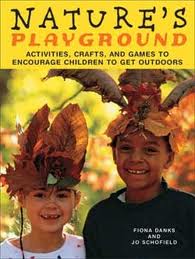
Nature's Playground
Nature's Playground is an amazing book by Fiona Danks and Jo Schofield that will inspire your family with all kinds of outdoor adventures.
The book is divided into seven sections: "Let's Get Outdoors" is filled with basic getting started tips. Four seasonal sections are filled with all kinds of wonderful things to build with natural materials from that season from twig sculptures in "Spring" to elf houses in "Autumn" to ice mobiles in "Winter". "All Year Round" describes activities you can do any time like tree climbing, scavenger hunts, and wild dens. "After Dark" describes nighttime adventures and crafts.
The book is a feast for the eyes with beautiful photography throughout. Even my non-reading children love to pour over the pages to get ideas of things to do. For those who want or need more inspiration, the text describes where to go and what to bring and how to get started for each of the pictured activities.
If you are looking for some inspiration to enliven outdoor walks with your children, this is my favorite of the nature activity books out there!
Thursday, March 3, 2011
Bringing Music to Life
For your convenience, I've placed links to some of the products listed in my Amazon store. You may also use this link to go directly to Amazon. As an affiliate, I receive a small commission on items sold through my store or my affiliate link.

In my Catholic high school, we took one semester of Music and Art in the Western World, more commonly known as MAWW. Naturally, because it was a Catholic school and the Catholic Church initially paid for much of the western world’s art and music, most of what we studied was religious in nature.
Now, while I did not have any issues with the pieces covered, I knew I had missed a huge chunk of western music.
So, when we decided to incorporate music into our homeschooling, I felt at a loss. What did I really remember after all these years? How could I make it interesting, not killing all enthusiasm for the subject?
First, I decided that I was not going to make music a “subject.” I was going to find a way to make it part of our lives.
We had always had CDs in the player, and neighbors on their daily strolls would see us dancing around like fools. Still, I wanted to expose my family to more classical pieces than Tom Jones (O.K., he is a classic) and Madness. I purchased Best Classics 100 Volume 1 and 100 Best Baroque CD sets. We played the CDs at home and in the car, discussing which pieces were our favorites and which we wished we could skip. Naturally, we did not always agree on the pieces, so we would have to sit through something someone else loved, waiting for our favorite. This provided the opportunity to share what we liked about our favorites, which occasionally gave the others an appreciation for the piece.
In my Catholic high school, we took one semester of Music and Art in the Western World, more commonly known as MAWW. Naturally, because it was a Catholic school and the Catholic Church initially paid for much of the western world’s art and music, most of what we studied was religious in nature.
Now, while I did not have any issues with the pieces covered, I knew I had missed a huge chunk of western music.
So, when we decided to incorporate music into our homeschooling, I felt at a loss. What did I really remember after all these years? How could I make it interesting, not killing all enthusiasm for the subject?
First, I decided that I was not going to make music a “subject.” I was going to find a way to make it part of our lives.
We had always had CDs in the player, and neighbors on their daily strolls would see us dancing around like fools. Still, I wanted to expose my family to more classical pieces than Tom Jones (O.K., he is a classic) and Madness. I purchased Best Classics 100 Volume 1 and 100 Best Baroque CD sets. We played the CDs at home and in the car, discussing which pieces were our favorites and which we wished we could skip. Naturally, we did not always agree on the pieces, so we would have to sit through something someone else loved, waiting for our favorite. This provided the opportunity to share what we liked about our favorites, which occasionally gave the others an appreciation for the piece.
Next, came across a treasure-trove of vinyl albums on our local FreeCycle list. I think we ended up with 30+ recordings, including classical, jazz, ballet, holiday, and more. We listened to the same piece led by different conductors and discussed the differences. We heard music we had never experienced and some we recognized from favorite films or even commercials.
Then I learned about Beethoven's Wig, sing-along versions of the classics. Some were so hilarious, they had us in tears! What I found fascinating was that my boys would only actively listen to the sing-along versions for months, while passively listening to the original versions simply because we left the CD playing, until they suddenly only wanted to listen to the original versions. In fact, my eldest is now learning some of the pieces with his piano instructor. (We gave our piano instructor the first Beethoven’s Wig CD, so he could discover the appeal for himself.)
For Christmas, we received Can You Hear It?, by William Lach, a Senior Editor at The Metropolitan Museum of Art. The book and CD set includes 13 tracks matched with 13 works of art. For example, Antonio Vivaldi’s Four Seasons - Winter I Allegro Non Molto is paired with Pieter Brueghel the Younger’s A Winter Landscape with Skaters and a Bird Trap. Questions include “Can you hear the first skater out on the ice, showing off in big loops and figure eights?” The explanation follows, “The solo violin plays the skater, using quick notes to show the gliding motion.” Wonderful! We sit together with the book in our laps, as we listen to the CD.
We also discovered Leonard Bernstein - Young People's Concerts / New York Philharmonic
on DVD. Leonard Bernstein was a modern composer (West Side Story), conductor, and general lover of music. Despite the early shows being in black and white (usually a death knell with modern children), we sit glued to the television when watching the concerts. Bernstein discusses all aspects of music: what does music mean, humor in music, folk songs, what is American music, sonata form, and so much more. Every point is enhanced with music. The audience participates. And Bernstein’s passion for music flows through each episode.
Music permeates our lives. We listen to it, discuss it, and see it in the world around us. We readily share our opinions (no shortage of opinions in our household), find a variety of music “dance-worthy,” and now have lives filled with music.
Article by Sarah J. Wilson
Then I learned about Beethoven's Wig, sing-along versions of the classics. Some were so hilarious, they had us in tears! What I found fascinating was that my boys would only actively listen to the sing-along versions for months, while passively listening to the original versions simply because we left the CD playing, until they suddenly only wanted to listen to the original versions. In fact, my eldest is now learning some of the pieces with his piano instructor. (We gave our piano instructor the first Beethoven’s Wig CD, so he could discover the appeal for himself.)
![]() |
For more resource ideas,
check out GHF’s Resource Review page. |
We also discovered Leonard Bernstein - Young People's Concerts / New York Philharmonic
Music permeates our lives. We listen to it, discuss it, and see it in the world around us. We readily share our opinions (no shortage of opinions in our household), find a variety of music “dance-worthy,” and now have lives filled with music.
Article by Sarah J. Wilson
Subscribe to:
Posts (Atom)