Showing posts with label history. Show all posts

Tuesday, September 4, 2012

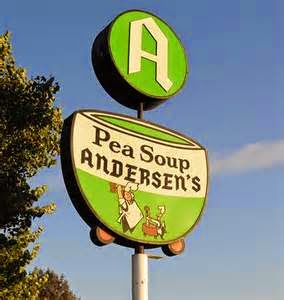
Pea Soup Andersen's

I have traveled up and down California more times than I care to count. And on every long road trip, I see the signs for Pea Soup Andersen's. Not being a pea soup fan, I never felt the urge to turn off the road and head to Buellton, but on a recent road trip, I figured it was about time I checked out the restaurant with the ubiquitous highway signs. So, at the crossroads of Hwy. 101 and Route 246, we pulled off and headed on our latest adventure.

Set in the California Danish heartland of the Santa Ynez Valley, Pea Soup Andersen's evokes the Danish settlers who came to California in the 1860s. The building keeps in theme with the many Danish-style homes, shops, and hotels in the area. In addition to the restaurant, you'll find a bakery and large shop, filled with knick-knacks, Danish blue and white pottery, and road games for the kids, as well as a year-round Christmas shop.

But our favorite parts of the restaurant didn't cost us a dime (or a krone). First, just outside the front door is a long plaque with carictures of all the Danish monarchs, going all the way back to Gorm the Old. Did you know that that Danish monarchy is the fourth oldest continual monarchy in the world, at over 1,000 years? And that it is now a constitutional monarchy? We spent quite a while looking at the different monarchs, discussing what they must have been like based on their drawings and names. Harald Bluetooth, Sweyn Forkbeard, Harald the Soft, Olaf Hunger, Eric Evergood, Eric the Memorable, and on and on. What glorious names! No mention of the Hamlets, though.
For more field trip ideas,
check out GHF's Virtual Field Trips page.

Inside, in an attempt to drag the kids away from all the shiny treasures for sale, we headed upstairs to see what we could discover. Lo and behold, an entire room dedicated to the history of Buellton! Pictures, descriptions, objects, maps. Why is it called "Buellton"? How and why was Hwy. 101 developed and improved? How did folks of yore manage to get through the Gaviota Pass? What made the dairy farmers so successful? What were some of the tools people used? Learning history on such a local level helps personalize the experience, reminding us that history is the story of people, not just dry words in an oversized textbook.

So, as you're traveling up and down Hwy. 101, stop in Buellton at least once. Even if you don't have a meal there, Pea Soup Andersen's offers food for the mind. But the pea soup is pretty good!

Saturday, August 11, 2012

Historical Sites

As you travel the highways and byways of our nation, have you noticed the tan and brown historical landmark signs? Have you been tempted to check out the site, but wondered if the detour would be worth the time? What if you could see photos of the site, read a review, and discover other nearby sites?

The Historical Marker Database (http://www.hmdb.org//) is the perfect site for experienced and would-be explorers. The organization describes its website as an "illustrated searchable online catalog of historical information viewed through the filter of roadside and other permanent outdoor markers, monuments, and plaques." Through photographs, written descriptions, inscription transcriptions, and maps, travelers can learn about local, state, national, and even global history.

Information is updated by fellow travelers and edited by volunteers. The website is searchable by word, phrase, category, county, state, province, or country. Basically, no matter where you are, you have the chance to learn about the history and people.

For more field trip ideas,
check out GHF's Virtual Field Trips page.
While the website is a great planning tool for trips, what makes this database really spectacular is that you can install it, for free, as an app on your smartphone (http://www.appbrain.com/app/historical-marker-database/com.ericwikman.hmdb). Using your phone's GPS, the HMdb will find your location and list a number of historical sites near you, complete with the same information as on the website.

We've used the database to discover historical markers near our home. We've used it to find interesting
places to take a break during long road trips. We've researched landmarks that we previously had passed hundreds of times and wondered what was so special. We have seen and learned more about our home and state because of this database.

Traveling doesn't need to be about getting from point A to B. Just like life, it can be about meandering, discovering, and learning. The Historical Marker Database can be an important tool on your journey.

Friday, June 1, 2012

Museum of Making Music

Interested in introducing your family to the music and musical instruments of the 20th century? Then the Museum of Making Music is a must-see for you!

Located in beautiful Carlsbad, California, right next to Legoland, the Museum of Making Music is a hidden gem. Tucked away in an office complex, it's easy to miss, but don't make that mistake!

Organized into five galleries, MOMM begins with American music at the turn of the 20th century. Each subsequent gallery covers two decades of American music and the history that inspired it. Period instruments, on loan from manufacturers and collectors, line the walls. Interactive displays allow visitors to hear what the instruments sound like, as well as music from the era. Marketing, distribution, and innovations of each era are covered, giving a complete sense of the development of the American music scene.

But, best of all, each gallery has at least one hands-on instrument for visitors to play. What a terrific way to engage children in the sounds and experience of music. In Gallery Five, the museum has at least a dozen hands-on instruments, as well as an interactive wall-sized computer screen for visitors to learn about World Music.

Entrance to MOMM is very reasonable, and they accommodate school, homeschool, and scout groups.
For more field trip ideas,
check out GHF's Virtual Field Trips page.


In addition to the galleries, MOMM hosts regular music events, some of which are free. Check online for details.

If a visit to the museum isn't in your future, still take the time to check out the MOMM website. It is filled with information geared toward education.

MOMM is one of those museums that we didn't know we needed until it was built. Now, it is a reason, in-and-of-itself, to visit Carlsbad.

Wednesday, May 18, 2011

Hiller Aviation Museum

The Hiller Aviation Museum, in San Carlos, California, offers a terrific aviation experience for flight fans of all ages.

Focused on the many historic achievements in flight from Northern California, the museum is filled with exhibits dating back to the dawn of flight in the 1800s, including the Avitor (an "aeroplane" that flew on the San Francisco Peninsula), a replica of the 1903 Wright Flyer, and the Buhl Autogiro (a precursor to helicopters). The present includes a Pan Am Clipper, Boeing SST, and an exhibit about Women in Aviation. The future looks to the Oblique Wing, Blended Wing, and NASA Swing Wing. Engines are displayed, as are jet packs.

But the museum is not just about looking, it is also about experiencing. Visitors can try their virtual hand at flying and landing a flying platform and a helicopter, and check out the Flight Sim Zone.

Just outside the museum building sits the front end of an actual Boeing 747, where visitors can climb into the cockpit and see the incredible amount of switches, levers, and controls pilots use to keep a commercial jet going.

A children's area is provided downstairs with riding airplanes, coloring, and other hands-on activities for little ones.
For those interested in learning how old aircraft are brought back to life, the museum has a restoration workshop where visitors can watch through huge windows the dedicated craftsmen preparing new exhibits and lovingly restoring aviation's past.

For more field trip ideas,
check out GHF's Virtual Field Trips pageal Field Trips page.
The museum also provides many education and scout programs, as well as a monthly reading time and the Captain Michael King Smith Research Library. The museum store offers an extensive selection of aviation books, posters, crafts, gifts, and toys.

For airplane and helicopter watchers, the museum sits right next to the San Carlos Airport, and even has a raised observation area.

Finally, just down the road is a flight-themed Burger King, complete with an actual helicopter for children to play in and have their imaginations take flight.

Location, directions, admission hours, tickets prices, and membership information can all be found at the Hiller Aviation Museum's website.

Article by Sarah J. Wilson

Monday, May 16, 2011

The Bible as Literature


Living where I do, one comes across many homeschoolers who are not Christian. A significant portion of those, while comfortable teaching ancient Greek and Roman mythologies, Native American belief systems, and perhaps even Eastern religions, struggle with Judeo-Christian beliefs.

While I am not here to debate the veracity of anyone's belief system, I will argue that students must read and understand the Bible if they are to have a full education.

How can anyone understand disputes in the Middle East without knowing Hebrew history as told in the Bible? How can anyone understand the symbolism of Western art and architecture without knowing the biblical parables and characters? A deeper knowledge of Western literature, history, medicine, and science are lost if the Bible is ignored. Current events are even more confusing if ancient history and beliefs remain unknown.

Studying the Bible (or any other religious text) is best done as a family. Parts of the Bible are contradictory, inflammatory, or even risque. Children's bibles and biblical story books gloss over this, naturally. But, if we are treating the Bible as "literature," then we must address it as is, warts and all.

An excellent study Bible, one often used in college "The Bible as Literature" courses, is The Oxford Study Bible: Revised English Bible with Apocrypha. Written in modern English, The Oxford Study Bible contains much more than biblical text and the usual explanation of abbreviations. This version includes "Reading the Bible," "Literary Forms of the Bible," "Communities in Context," "The Literature of the Biblical Communities," "The Communities' Experiences of God," "Select Index to People, Places, and Themes in the Bible," and 14 indexed maps.

The Old Testament, Apocrypha, and New Testament are annotated, adding clarity to confusing passages and historical context lost on modern readers. Each book begins with a brief explanation of the book's historical and spiritual intent. Headings at the top of each page give a one-sentence summary of the content, allowing the reader to have an overview of what's happening.

Studying the Bible in conjunction with other subjects adds a deeper understanding to both endeavors. The poetry of the Bible inspires poetry of today. The battles fought in the Old Testament fortell the battles still fought on the same ground, thousands of years later. The contradictions within the Bible feed the contradictions within the various sects of Judeo-Christian belief. The humility of the great leaders in the Bible are examples for leaders of today. The hubris of others also stands as lessons for those same leaders.

Use the Bible as a jumping off point for discussion and debate. Why are there two creation stories in Genesis? Why does the lifespan of mankind decline as we go through the ages? How does the personality of God change from the Old Testament to the New Testament? Why was the Apocrypha debated, partly included, completely excluded, and still not a consistent part of the Bible? Why were none of the four Gospels included in the New Testament written by anyone who actually knew Jesus? What similarities do you see between stories and parables in the Bible and other religious writings, and what does that tell us about what is important to humanity? How are women depicted in the Old Testament compared with the New Testament, and why the change? Why has the Bible, in one form or another, inspired people to great good and great evil for over two thousand years? (Remember, the Bible is a Christian document, and includes the Old Testament to illustrate Christianity's link to and succession of Judaism through Jesus, a Jewish carpenter, born of a Jewish mother.)

As a society, we have already lost so much in our understanding of our past through the loss of regular study of Greek, Latin, and ancient texts. If we toss aside the Bible as well, our history, literature, and art will become all the more shallow and meaningless.

Article by Sarah J. Wilson

Thursday, May 5, 2011

"The 10 Things All Future Mathematicians and Scientists Must Know (But are Rarely Taught)"

With great power comes great responsibility.[1]

Budding mathematicians and scientists would be best to remember this. Simply because one can understand complex theories, does not preclude one from making common errors.

The Ten Things All Future Mathematicians and Scientists Must Know (But are Rarely Taught), by Edward Zaccaro, lays out ten concepts to guide students to more critical and honest thinking. Students don't need to become mathematicians or scientists to benefit from these ideas.

By discussing actual events that were affected by the misunderstanding or delibrate disregard of facts and calculations, Mr. Zaccaro brings home the importance of understanding and accepting what numbers mean.

We adults can probably think of tragedies in our lifetime that ultimately came down to math or science: the Challenger explosion, the Kansas City Hyatt Regency walkway collapse, the death of Aaliyah. The Ten Things explores how these events could have ended differently, had the numbers and facts been taken seriously.

Fortunately, not just tragedies are covered. Mr. Zaccaro uses the strange world of average speed, cold fusion, the Mars Climate Orbiter, ulcers, psychic surgery, doctors who were fooled, the Bermuda Triangle, how ethical decision-making saved a company, knee surgery, and more to discuss why mathematicians and scientists (and, arguably, all of us) need to move beyond the cold facts and figures, instead utilizing them to make better decisions, safer choices, and strongly-founded conclusions.

Each chapter supplies several examples of incidents which support the topic. Each example is reviewed, the mistakes laid out, and then followed by discussion questions. The questions range from specific (why was something done) to open-ended (what do you think).  Along the way, mathematic and scientific concepts are introduced and explained, never assuming the reader is an expert, but always teaching. Additional questions are given at the end of each chapter, ranging in difficulty from "Level 1" to "Einstein." Answers and explanations are in the back.

Lest all this sound overwhelming, rest assured that the book is appropriate for middle-school and higher. Of course, don't hold back the book if a younger child is interested in reading it. (My eldest son first read it when he was seven.) I would also encourage parents to read it, as we could all use a refresher course in critical thinking, especially when we're inundated with "facts" and "truths" through media, the Internet, and "friends of friends."

The Ten Things All Future Mathematicians and Scientists Must Know (But are Rarely Taught) is an excellent companion to any math or science program. It also works as a stand-alone book for inviting family discussions, a part of family life-long learning.

[1] This quote, in various forms, is attributed to Jesus of Nazareth, Voltaire, Rudyard Kipling, Karl Marx, FDR, Stan Lee, among others. (http://www.newsfromme.com/archives/2005_10_06.html; http://en.wikipedia.org/wiki/Uncle_Ben#.22With_great_power_comes_great_responsibility.22)

Article by Sarah J. Wilson

Sunday, May 1, 2011

Things We'd Like to See: The Magna Carta

Freedom. Citizens' rights. Constitutional government.

We in the United States of America all too often take these for granted. For generation upon generation we have lived with peaceful government transitions, the ability to challenge and test our rule of law, limited government power, and the right of the people to be heard.

Despite what many Americans might believe, this didn't begin with the the Declaration of Independence. Instead, the path to individual rights was forged centuries before with the Magna Carta in 1215.

The Magna Carta, literally the "Great Charter," granted political and civil liberties, greatly preducing the power of the English monarchy and allowing for the formation of a powerful Parliament. King John of England (1166 - 1216) was forced to sign it by Archbishop Stephen Langton and the most powerful barrons of England. This document forced the king to govern by pre-Norman laws and demonstrated that the reach of the monarchy could be limited by written edict.

The power of this document cannot be understated. Its influence can be seen in current British law, the Declaration of Rights in the Maryland Constitution of 1776, the U.S. Constitution, the Bill of Rights. Five and a half centuries before the Revolutionary War, the Magna Carta laid the groundwork for separation of Church and State, levying of taxes, right to trial by jury, and uniformity of weights and measures. While not a perfect document, (women's rights are virtually non-existent), it was an enormous leap forward in thinking and action.

We in the greater San Francisco Bay Area can now view this truly revolutionary document at the Legion of Honor. On loan from the Bodleian Library at the University of Oxford, the manuscript will be on view from May 7 through June 5. This once-in-a-lifetime event is an extraordinary opportunity to see the power of the written word.

When considering visiting this exhibit, please don't limit it to older children and youths. If you're able to go with other adults who can help with little kids (take them outside when the wiggles strike), please do. This document is intrinsic to all our lives. It's up to us, as homeschooling parents, to make it relevant to our entire family. Older students can certainly learn about and appreciate the Magna Carta's historical significance; younger students can focus on the interesting writing and colors, talk about the picture on the wax seal, or watch the people coming to visit. The Legion of Honor has many other on-going exhibits, as well. If you keep in mind these Tips for Successful Museum Visits, everyone should gain something positive from their visit.

For more field trip ideas,
check out GHF's Virtual Field Trips page.
Admission is reasonably priced at $10 for adults, $7 for seniors, $6 for youths 13-17 and students with valid ID, and free for children 12 and under.

For more information on the Magna Carta, check out the following links:
Magna Carta to make rare appearance, San Jose Mercury News, 4/06/11
Legion of Honor, Magna Carta
Translated text of the Magna Carta
Magna Carta 1215
Wikipedia: Magna Carta
Books about the Magna Carta

Article by Sarah J. Wilson

Wednesday, April 27, 2011

"Exploring the Back Roads": Stretch Your Field-Trip Muscles


This post contains Amazon Affiliate links. As an affiliate, I receive a small commission on items sold through my store or my affiliate link.


Homeschoolers love field trips. What better way to experience the world, than to actually get out and explore it?

Sometimes, however, we find ourselves stuck in a rut. We start going to the same museums, the same parks, the same historical sites. The kids get bored. We get bored. And the family ends up staying home.

If you live in, or plan to visit, the Bay Area of California, you now have no excuse! Peter Browning's book, Exploring the Back Roads: 28 Day Trips in the Greater Bay Area, is filled with new and interesting suggestions for places to go.

Dedicated to "the guy who invented second gear and the illegal U-turn," Browning's book opens up a world of field trips to even the least adventurous among us.

Exploring the Back Roads divides the greater Bay Area into four areas: Marin to the Sonoma Coast; Wine Country to the Geysers; Carquinez, the Delta, and Contra Costa; Santa Cruz Mountains, the Coast, and Old San Juan. Naturally, distances to these areas varies greatly depending on where in the Bay Area you live, but most can be easily done in one day. If some seem a bit far, include them in a two- or three-day trip, or tack them on to a road trip headed to a far-flung destination.

Browning provides plenty of information about each trip, such as pictures, maps, history, nearby parks and restaurants of interest, and so on. The ultimate destinations aren't an end unto themselves, but part of a greater journey on picturesque roads, past beautiful scenery, and through parts of our area most people miss.

Our family has done a few of the field trips (Lick Observatory, San Juan Bautista-Fremont Park, Santa Cruz to Castroville), adapting the suggested sites and drives to suit our family's interests and needs. We have noted even more of Browning's suggestions in our "Places We Like To See" binder (look for more information in a future article).

For more field trip ideas,
check out GHF's Virtual Field Trips page.
A few suggestions for those using Exploring the Back Roads, or any other travel guide:
1) Check, either online or by phone, for current hours at your destination. Browning last updated his book in 2006, and some locations have made changes since then.

2) Map out your excursion using online or printed maps. You will get a better idea of actual drive times and distances from your location.

3) Either plan ahead for bathroom breaks, or be on the lookout while driving. I never cease to be amazed at how fast a child's bladder works once in the car.

So, pack a picnic, belt those kids in the car, and hit the road. Book-learning is good, but real-life learning is amazing!

Article by Sarah J. Wilson

Thursday, April 21, 2011

Places We'd Like to Visit: The Museum of American Finance

Money fascinates my eldest son. The variety of currencies. Their monetary relationship to each other. The power money wields. How money creates more money. So, when we read about the Museum of American Finance in the Wall Street Journal (Making Money a Must-See, April 16-17, 2011), we were itching to pack our bags and head to New York.

The Museum of American Finance (MOAF) is "the nation's only independent public museum dedicated to celebrating the spirit of entrepreneurship and the democratic free market tradition which has made New York City the financial capital of the world." Nowadays, many people may believe the free market system is broken, but regardless, understanding the foundation and history of our nation's financial markets can only lead to a better informed consumer and citizen.

MOAF boasts an interactive monetary exhibit, a gold Monoploy set, a historical display of piggy banks, interviews with 16 modern-day entrepreneurs, the Alexander Hamilton Room dedicated to our first Secretary of the Treasury, information on the current credit crisis, and information on past financial scandals.

The museum also offers classes at the Center for Financial Education. Classes range from "Real Fake" with Inspector Collector, aimed at grades K-6, to The Secret Life of Money: Currency Exploration for Adults, designed for college students and adults.

Hours, admission rates, and directions are available at http://www.moaf.org/contact/index.
For more field trip ideas,
check out GHF's Virtual Field Trips page.

Unfortunately, at a time when our need for financial education is stronger than ever, the MOAF, which offers just the information we need, isn't doing well. Perhaps, people are intimidated by the name "American Finance." Or, maybe, people believe money is boring. Or, perhaps, folks believe they know all they need to about how money works. Regardless of the reason, one of the more important aspects of our modern lives is completely neglected in traditional teaching, so people must make the effort to seek out the information to teaching both themselves and their children. Only with knowledge will we avoid the mistakes of the past.

So, whether you're an argentum-phile (money lover) or argentum-phobe (money fearer), MOAF sounds like wonderful place to learn more about and experience the fascinating world of finance.

With a little luck, and money, maybe we'll see you there!

Article by Sarah J. Wilson

Tuesday, April 12, 2011

"The Presidents: The Lives and Legacies of the 43 Leaders of the United States"

In 2005, the History Channel aired the documentary named The Presidents: The Lives and Legacies of the 43 Leaders of the United States. Now available in a three-DVD set, this series gives fascinating insight into the men who have shaped our government, our nation, and at times, the world.

Each president is treated with equal time, based on the number of terms served. So, George Washington gets the same amount of time as Ronald Reagan (both two terms), John Adams the same as George Bush (both one term), with Franklin D. Roosevelt having the most (four terms).

The subject matter could have been dry and boring, but is instead delivered with visual and auditory variety. Talking heads discuss the various goals, accomplishments, and failures of the presidents; pictures of homes, family, contemporaries, political cartoons, and documents are presented; and a “baseball card” is created for each president, with his picture on the front and interesting personality and attitude insights as “stats” on the back.

The history delivered only covers the presidents’ terms in office. If they held other office prior, it is glossed over. If they were military men, it is briefly mentioned. The point of the series is to talk about these men as presidents, without delving into their past for clues to their actions.

This is not a “rah rah, U.S.A.” piece. Both the good and bad of our country are discussed. Presidential decisions that prolonged slavery. Actions that led to civil war. Doctrines that bring shame.

The series is a wonderful overview of our presidents: the strong and the ineffectual, the healthy and the ill, those with good intentions and those with none, those who strived for the presidency and those who found it thrust upon them.

One of the bonus features is All the Presidents’ Wives, which goes through the women behind these men. One hears so little about the wives, which makes this interesting viewing. The only complaint is that, unlike the main series, it is not chronological. Instead, it is organized by attributes. So, a wife may be discussed in more than one context. This became boring for my very logical thinker, but may not be an issue for other viewers.

The Presidents has been watched numerous times in our household and spawned a greater interested in U.S. history, as a whole.

Article by Sarah J. Wilson

Thursday, April 7, 2011

"A Guided Tour Through the Museum of Communism"

To be interesting and relevant, the study of history should include the stories of the people who actually lived it. Dates and battles are all very well, but by personalizing the experiences, we can better relate to the people who suffered or benefited from the larger picture.A Guided Tour Through the Museum of Communism: Fables from a Mouse, a Parrot, a Bear, a Cat, a Mole, a Pig, a Dog, and a Raven, by Slavenka Drakulic, tells stories of life under the Communist regimes of Eastern Europe from the point of view of animals.
By choosing to use the voices of animals, Ms. Drakulic makes the stories more approachable. These are not people whining or justifying their actions (or inactions); instead, we hear animals explain why people did what they did.

Not all the tales explain how the common people lived. In fact, we hear from a parrot which enjoyed the luxurious lifestyle of living with "the Marshal." We learn a mole's point of view about the "fabled" Berlin Wall. The "oldest dog in Bucharest" tells us of life after the fall of Communism.

Ms. Drakulic understands how quickly people forget the horrors of the past. Generations who have never lived under the shadow of totalitarian regimes find the stories of the elders strange and fantastical. Why didn't people rise up? Why did people turn in each other? Why didn't more escape? Why did people tolerate the intolerable?

Despite the use of animals as narrators, this book is not for younger readers. Some of the stories are dark and refer to great cruelties.

A Guided Tour Through the Museum of Communism would serve as an insightful adjunct to Cold War, European, ideological, or similar studies. Families could discuss how they would have hoped to have acted in each story, as well as how they more likely would have behaved. Students could be encouraged to write their own fables about atrocities they see in our world. For example, why do neighborhoods tolerate gang violence? What would it be like to talk with a high-ranking official about a major indescretion that must remain hidden? How do the homeless maintain a sense of humanity and community? What does poverty look like from the perch of extreme wealth?

Homeschoolers understand that deeper understanding rarely lies in the pages of a textbook. Books, such as A Guided Tour Through the Museum of Communism are what add depth and color to our learning experience.

Article by Sarah J. Wilson

Sunday, March 27, 2011

"You Decide!": Studying the Bill of Rights

Many say the Constituion of the United States of America in an inspired document. But, when it came time to ratify the Constitution, many states felt that it did not guarantee specific rights to the people. Without this "bill of rights," the Constitution faced rejection. So with a promise to work on a Bill of Rights, the Constitution was adopted on September 17, 1787. The Bill of Rights followed over four years later, on December 15, 1791.

No American education is complete without studying this vital document. What rights are guaranteed? Why did the founding fathers feel compelled to address these specific issues in the first ten amendments to the Constitution? How have these rights been challenged and upheld? What is the process?

You Decide! Applying the Bill of Rights to Real Cases, from The Critical Thinking Co., helps students learn about the Bill of Rights by casting the students as judges in ruling on 75 cases that went before the U.S. Supreme Court.

Each sections follows the same format:
You Be the JudgeStudents read two U.S. Supreme Court cases and answer questions about how they would rule.

What Does the Amendment Say?Students read the actual amendment. Then, the amendment is broken into segments, new vocabulary is defined, and then restate the amendment in their own words.

Some Past Decisions of the Supreme CourtA number of cases, with their backgrounds, are presented. Students use the Guide for Analyzing Cases, which helps the students break out the main facts of the case, what amendment was involved, what particular clause of the amendment was involved, what state law or provision (if any) was allegedly involved, what were the issues of the case, what the U.S. Supreme Court decided, and why the Court decided as it did.

What are the Origins of the Various ClausesThe Bill of Rights was not written in a vacuum; it can only be understood within its historical background. While the Court must rule with present considerations in mind, deeper comprehension comes with learning the reason the founding fathers felt these rights must be guaranteed in writing.

The Amendment TodayHow do these amendments affect our lives today? How have the Court's rulings secured and honed our rights?

The workbook and answer guide (You Decide! Instruction/Answer Guide Applying the Bill of Rights to Real Cases) are designed to be used in a student/teacher situation. Discussion points, question sheets, multiple-choice questions, and the Guide for Analyzing Cases provide thoughtful interaction and comprehensive methods to gauge understanding.

Another option for studying with the books is to use them as a jumping off point for family discussions. In our family, we instituted "Constitutional Law at Dinner." The name appeals to our children, but what they really enjoy are the discussions. Once or twice a week, while eating dinner, we work throught the book together. One night we read an amendment and discuss what it means. Another, we talk about its historical context. On yet another, we read two or three cases and say how we would rule and why. Sometimes we agree, but often we don't. Each person must support their opinion. If they struggle with their reasons, we work through it together. Then we read how the U.S. Supreme Court actually ruled and discuss why we agree or disagree. Occasionally, we really haven't understood the ruling, so we go back through the specifics of the case. Although we may still disagree with the ruling, we better understand it.

We can easily stay on one amendment for a couple of weeks, as You Decide! presents many cases and plenty of background information. Although the workbooks are geared toward grades 6-12+, by discussing them as a family, younger children will pick up concepts and vocabulary, as well as learn how to participate in friendly debates.

With You Decide!, our entire family has gained a deeper appreciation for the Bill of Rights and for the impressive document it is.

Friday, March 11, 2011

Studying the California Flag

When studying California history in school, one usually begins with the various Native American tribes, moves on to the Spaniards and missions, then the Gold Rush, and boom, we’re a state. While the chronological approach has value, perhaps finding a jumping-off point for delving into our great state’s history would be more interesting to you and your children.

One recommended approach is starting with the California state flag: the Bear Flag. With just a little research, reading, and perhaps a field trip, a variety of learning angles quickly arise: history, politics, regional conflicts, ecology, non-native invasive "species" (Europeans and Americans, in this case), symbolism, and flag etiquette, for starters.

Start by either getting a picture of or acquiring an actual state flag. Why do we have a bear on it? What kind of bear is that? Why does the flag have “California Republic” on it? Why is there a single red star? All of these questions are lead-ins to a fascinating study. (You will not find answers here—this is a homeschooling column, not a school column—but you will find links to resources.)

Books you may want to read are:Rosie and the Bear Flag, by Harry Knill: The story of the Bear Flag from the end of the Spanish rule through the joining with the United States, as seen through the eyes of young Rosalie Leese, who was there.

Bear Flag Republic: Prose Poems and Poetics from California, by Christopher Buckley and Gary Young: Featuring over 90 poets from California, about California

California - A Place, a People, a Dream : A Journey Through California History, by Claudia K. Jurmain, James J. Rawls, Oakland Museum: A “panoramic view of the California dream from miwok baskets to silicon chips.”

To add music to your studies, listen to some of the many songs written about California. Did you know that California has an official state song? It’s not “California Here I Come.” Ever hear of “I Love You, California”?
For more field trip ideas,
check out GHF's Virtual Field Trips page.

As a side note, learning about our state flag fulfills requirement 2d (“Learn about the flag of your state or territory and how to display it/”) for the Wolf Badge in Cub Scouts. Going to a local history museum and walking around the area with your family fulfills requirement 10c (“Plan a walk. Go to a park or a wooded area, or visit a zoo or museum with your family.”). If you can add a city hall, justice building, or other historic location to your tour, you will complete requirement 4f (“Visit an important place in your community, such as a historic or government location. Explain why it is important.”).

Learn about the good, the bad, and the ugly of California: all by looking at our flag.

Article by Sarah J. Wilson