Showing posts with label early childhood. Show all posts

Monday, June 27, 2011

Snails Pace Race

Snail's Pace Race is a lovely first game for any child.  Six colorful snails line up at one end of a game board.  Players take turns rolling two colored dice.  Whatever colors you roll allow the snails of corresponding colors to move forward one space.  If both dice show the same color, that snail moves two spaces.  The snails race toward the finish line, so you are free to cheer for whichever snail you desire, or change allegiances when your favorite gets behind.

This simple cooperative game teaches the basics of game play (turn taking, dice rolling, and moving one or two spaces at a time) without the stress of winning or losing.  My children often wanted to play until all the snails passed the finish line or wanted them to turn around and race back to the start.  Appropriate for ages three and up, it is a great introduction to the world of board games.

Wednesday, June 1, 2011

For the Love of Boxes

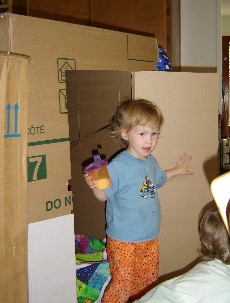
When you are a kid, sometimes the best things from the store are not the toys, but the boxes they come in. Every parent has a story of the birthday when the birthday child was more interested in the box and wrapping paper than the toys within. We've taken this to the logical conclusion with our second and third children: we went to the appliance store and hauled away a big washing machine box and gave it as a first or second birthday present!

We cut doors and windows into the box before gifting it. We usually mix cut out holes of various shapes and heights with one or two doors or windows that are "hinged". (Hint: for a better hinge, cut through the first outer layer of cardboard to create a crease where the door or window is to open.) We've learned it's a good idea to cut a little rectangle of cardboard out of the edge of the door so there's a place to stick your fingers in to open and close it, otherwise you get the occasional pinched finger!

These boxes get written on, pushed over, sat on and otherwise loved and abused until it's finally time to put it in the recycling. For inspiration, look for the book Christina Katerina and the Box, (now out of print) as a guide for how your box may transform over time.

Wednesday, May 11, 2011

Fridge Phonics: a useful "noisy" toy

Fridge Phonics is one of the few "noisy toys" that I recommend. Although reading the English language is full of exceptions to the rule, knowing the most common sounds which letters make is useful to most children when they are first learning to read.

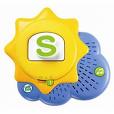
Fridge phonics consists of 26 raised letter magnets and a magnetized base. When the letters are placed in the base and pressed, a song begins, such as, "F says fff, F says fff, every letter makes a sound, F says fff." For vowels, the long and short sound are included, as in "A says aa and A says aah, every letter makes a sound, A says aa-- and aah!" The tune is catchy, you will find yourself singing it under your breath, which is why it's such a novel and useful toy. Your kids will be singing it, too, and dancing to it while learning the names of the letters and their most common sounds.

This toy works well for kids who are very auditory, who already like to sing catchy tunes. The letters are in strong relief, so they stand out visually. When held, the shape of the letter is easy to trace with your fingers. They can be used on the refrigerator to spell words with no repeating letters. I watched my son at a fairly young age use the toy to figure out which letters he needed to spell his choice of words.

The letters are all uppercase, although expansion packs for lowercase letters have been available in the past. Also, sometimes the sounds of the letter are not as clear as they could be. You may need to sing along so your kids can see the shape of your mouth as you form some of the sounds.

Thursday, April 21, 2011

Science Experiments for Young Learners

Science Experiments for Young Learners is a great resource for teaching science to the 4-7 year old age range. The book contains over 120 simple experiments that are conducted using mostly everyday items that are simple to collect. A broad range of concepts in physical science, life science, and earth and space science are demonstrated through a combination of demonstrations and simple experiments children can complete themselves.

Each experiment is shown in a two page spread. The right hand page is a worksheet that can be completed by the child either during or after the experiment. Sometimes the page is necessary, but often a parent could just talk with their child about their observations.  The left hand page includes a statement describing the concept, a short description of the experiment, a step by step explanation of how to perform the experiment, suggestions for follow-up questions and explorations, and a complete list of materials.

Most of the experiments can be completed in 15-20 minutes, although some require several days of observation (this is particularly true in the life science experiments).

This book is a great resource and could provide either the main lessons in a early childhood science curriculum or be a supplement to an existing text.

Thursday, April 14, 2011

Playful Learning: An Alternative Approach to Preschool

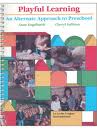
Parents who are planning to homeschool sometimes still want the social aspects of a preschool experience for their children.  One way to do this is by creating a cooperative preschool with a few other families.  A great resource to get your co-op preschool started is the book Playful Learning, published by La Leche League.  This book takes parents through all the steps of creating a preschool at home in cooperation with other parents as an alternative to sending children to a traditional preschool.

The first third of the book is about the reasons why you might create a co-op preschool and many details about the logistics of doing so including schedules, finances, organizing the space, etc.

The rest of the book is a treasure trove of activities perfect for small groups of children ages 3-5. Art, nature, cooking, math, early literacy, movement, and music are all given their own chapters. The activities are usually inexpensive and just right for preschool aged children. There's plenty here for several years of home based preschool!

There is a checklist in the appendix of the skills that are considered part of kindergarten readiness. This is an excellent tool for parents who want to know how their child is progressing and a great way for the parents planning a co-op preschool to make sure that they are including a variety of activities to develop a broad range of skills.

If you are a parent who has considered creating a co-op preschool as a way of creating the ideal environment for your child, this book has all the details to get you started. As a bonus, the skills you learn from creating a co-op preschool will transfer perfectly when you start to create learning clubs for your older homeschooled child!