Showing posts with label spelling. Show all posts

Thursday, April 28, 2011

Word Ladders

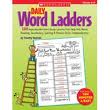
The Daily Word Ladders books by Scholastic are a great resource for building vocabulary and spelling skills.

Available for grades 1-2, 2-3, and 4-6, each book uses the same concept at increasingly difficult levels. Each page shows a ladder of 5 to 10 rungs. The first rung has a word. The second rung gives a clue for the word that belongs on the next rung and lines for each letter of that word. For instance, on one ladder the first word is "coat" and the clue for the next rung is "A black rock that produces heat. Change one letter." The activity continues in this manner, with clues to add, subtract, rearrange, or change letters to create a word with a particular meaning until you reach the top rung. Each page has a theme to which the top and bottom word belong-- so "hot" may be turned in to "cold" or "coat" turned into "glove".

The wonderful thing about word ladders is they combine the elements of a game with some great brain exercises. It's fun to discover that changing a single letter changes the sounds of almost all the letters around it. These books are a great addition to vocabulary and spelling curriculums.  We don't use them daily in our family, but they are a fun alternative to our regular curriculum.

Sunday, March 6, 2011

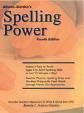
Spelling Power

If you are a homeschooler looking for one spelling program that can last you from third grade through high school, Spelling Power may be for you. The author has created a program based on the idea that students should learn to spell the most frequently used and frequently misspelled words using a multisensory practice method.

You will need to spend an hour or two going over the instructions at the beginning of the book for using the program, but here are the basics:


A fairly simple pre-test allows you to place your child on the correct level in the eleven levels of words, no matter what the child’s age. The words are then organized within the levels by their usage of the 44 sounds used in the English language, often the vowel sounds. For instance, a group of words may all use the long E sound but the spellings will include ea, ee, y, ie, ei, ey, and eCe. (Isn’t English just grand?) As you begin each list, you discuss the “rule” for how that sound can be spelled.

Daily spelling practice in this program is 15 minutes long. For the first five minutes you give a pretest for the words on the current list your child is working on: You say the word, use it in a sentence, your child repeats the word, spells it on his/her paper, then says the word again, you spell the word correctly, and your child immediately corrects it of wrong. When you get to the end of five minutes or the end of the list, you stop testing. At this point, your child usually has 1-3 words to practice.

For the second five minutes, your child practices the words. A study sheet leads the child through a multisensory practice which includes examining the word for patterns, saying the spelling aloud, visualizing the word with eyes closed, and using large muscles to write the word on a textured surface. The child also uses the missed words in a sentence of their own creation. The next day, these missed words are the first to be tested.

The third five minutes is devoted to activities from a menu in the back of the book to reinforce spelling skills. I will admit that we to do not do this step, but we do use similar activities at other times of the week.

The program is meant to be daily, and I will also admit that we use it twice a week, which seems to work well for our family. The word lists appeal to my sense of organization and the program does seem to work better than the traditional study 20 words, test, and forget method. I appreciate it that only the incorrect words are studied and retested and that the practice process is multisensory.

To mix things up, we sometimes use the word lists in other ways as we work through them. For instance, we input them into a computer program designed to practice more traditional lists and my son does those activities instead.

I’ve found the book to be a worthwhile investment, and recommend it for families who want a short and simple spelling program. It would best suited for children who like the consistency of a repeated activity as the daily work varies very little from day to day.

Article by Heddi Craft

Wednesday, March 2, 2011

Spelling DooRiddles

For your convenience, I've placed links to some of the products listed in my Amazon store. You may also use this link to go directly to Amazon. As an affiliate, I receive a small commission on items sold through my store or my affiliate link.


My eldest son is an advanced reader; however, this has not translated into advanced spelling. I wanted to find a fun way for him to learn to spell, without endless spelling lists or constant correction from Mom. So, when I read about DooRiddles, I thought we’d give it a try.

As the title implies, DooRiddles contains riddles, and these riddles encourage the reader to figure out two words. For example, the riddle on the cover is:

I am a garden pest,
And haul my
house with me;
But if you
drop the N,
I push the
boat at sea.

The answers are “snail” and “sail.” By using associative reasoning, reading comprehension, and spelling skills, the reader figures out the answers.

At first, my son was hesitant to start. It was something new, and it wasn’t math, so he was unsure. Now, it sits on our coffee table and is one of the books he chooses to work on three or four times a week. In fact, he checked out the back cover and asked for more from the series.  High praise, indeed!

Although he does the riddles mostly on his own, I do check them every now and then to find any repeated errors, but for the most part, it is self-correcting. If he knows how to spell one word, he can figure out the other. If he can’t figure out either, he comes to me and I give him hints.

One of the aspects I like is that the answers do not always rhyme, which I believe helps readers to works through English’s complicated spelling. For instance, the answers to one riddle are “even” and “seven.” They certainly do not rhyme, but they are visually the same. (Actually, it is a good starting point for discussing visual rhyming in poetry, if one is so inclined--but that’s just the English major in me.)

And just in case, the answers are included. But unlike most book, they are in the front, which I find leads to less peeking. Go figure!

Here’s a riddle for you (with apologies):

My authors’ names
May remind you of a man
Who to animals could talk;
But replace what is small
With what is puzzling
And you have spelling book
At which your children won’t balk!


By John H. Doolittle and Tracy A. Doolittle
Reading level: Ages 4-8
Paperback: 48 pages
Publisher: Critical Thinking Co (January 2, 2005)
ISBN-10: 0894559044
ISBN-13: 978-0894559044
List Price: $10.99 (available used)

Article by Sarah J. Wilson

This article was originally published in the April 2009 issue of "California HomeSchooler."